Thursday, December 07, 2006

Land Lessons and Wildflowers

Learning The Land
Thursday, December 7, 2006
When the snow begins falling here on the mountain at Vermont Flower Farm we know that winter will get serious at some point soon. That means we have to put ourselves in hyper drive to finish up all the odds and ends before the cold weather convinces us to wait for spring. I have been real busy at my real job lately so squeezing in more hours in a solstice-shortened day makes for a bigger challenge. Gail has been working on wreaths and other decorations and Alex has been assisting as he can.

I've cleaned truckloads of brush and dead trees from the new property and am feeling very good about the whole project. That would be "very good" and "very tired". I've already relearned a great deal about the property but there is a lot more I need to learn through all the seasons.
The heavy rains of the past week raised the Winooski River to flood stage down river and left pockets, puddles and deep pools of water at various places on our land. This watershed is very interesting because it is larger than first visible and there are several influences you must understand. The entire area up Route 215 to Cabot and Walden drains towards Marshfield where it is joined by what I call the Peacham Pond watershed. At some point I'll research this and get it all right but the Peacham part to me includes all the streams that flow into Peacham Pond which then flows down into the Marshfield Reservoir along Route 2. There are also streams from the Danville side. Part of that water comes down the valley to Marshfield and some of it is directed at the reservoir into a giant pen stock managed by Green Mountain Power. That water goes along Route 2, to the top of Water Tower Farm (hence the name) and then down the Cabot side of the mountain range to a small hyrdo plant.

This time of year Green Mountain Power opens the dam that controls Peacham Pond. With all the rain of last week including 3" in one night, the water levels were already very high. For some reason GMP decided it was time to reduce the pond level. I heard that the "controller" decided to drop the level a foot more right in the middle of the major flooding. As a result the Winooski, already running four feet above normal, went another couple feet up the banks. I'm sure there's more to that than I understand but the fact was a lot of water headed on its way to Lake Champlain.

Now that cold has come and rains have changed to snow, a walk along the river shows more damage along the way. Down river past Pike Road you can see where the river fluctuation is degrading the banks and dragging tons of silt downstream. It's an issue deserving of attention but so far I haven't figured how to approach it. There are a number of variables in the "energy crisis thinking" going on in Vermont and it's obviously difficult to keep everyone happy. The Winooski River is a fine resource and I personally think we need to pay more attention to its capabilities, both positive and less so. The erosion issues are paramount I think.

The point of mentioning this is the challenges is has created on how we will manage our new land. From a larger perspective, it reminds us of our need to learn lessons from any land we are considering for a new business so we don't spend money on something which can't produce what we want.

I recommend that you spend some time before buying anything. Unfortunately this has become more difficult in recent years because land has not lasted on the market very long and in many occasions the winning price becomes many thousands of dollars above the asking price. That market behavior has forced people to buy quicker without the opportunity to understand what they are getting into. It makes it incumbent on the buyer to spend more time more quickly walking proposed land. You have to do a quick study which is not easy for everyone to do.
We have had the opportunity to drive buy this land almost every day for many years. We already knew the soil type which was a concern but the location made the land more valuable. We knew the soil could be remedied over a few years and a few hundred tons of organic materials. The water is another issue and one which would be concern to many.

As we walked the land beginning on the west corner by Route 2, it was apparent how much water came off the adjacent mountain. Earlier this summer the Agency of Transportation crews replaced the old metal culvert with a new, one-piece 30" plastic pipe. Size alone would suggest how much water might come under the road at various times of the year. AOT are pretty good engineers and they understand how to size projects. To a potential buyer, this should have been a sign to look further.

The lay of the land shows evidence that at one point in the past the water from this culvert headed straight for the Winooski. This time the new road construction included dredging out a bit of ditch in front of the culvert and the water now heads towards Plainfield, using the fir balsams on the adjoining land as a giant sponge. At various points along the roadbed, water seeps out from the mountains across Route 2. Water hydraulics is very interesting and something any potential buyer needs to look for. We are just beginning to learn this aspect of our property. It's one of many things buyers should place high on their list. I'll write some more on this a little later.
New land and new gardens has to have a vision. Likely that vision will change over time but a plan is important. Over the past couple weeks I have cleaned up the area in this picture. All the dying and diseased trees are gone and the less desirable alders and willows have been removed. Towards the middle of the picture the land raises about 6 feet to a series of peaks and valleys left from the days when this corner of the property was the sand storage area for the village, town and state. I have to trace that story down further but it appears from the mystery of holes and pockets in this corner of land that this is probably true. I also need to determine is any roadsalt was stored there.

The understory of the remaining trees has left a great place for some of our wildflowers which is why I started with the trilliums. This past week I planted some baneberry seed and in three to five years that should be looking nice too.

Baneberry grows in red, white or pink and I planted seeds of the first two last week. This is an interesting plant which is somewhere on the "don't think of eating the berries" scale. The red variety grows quicker and maintains nice foliage until August when just like trilliums, it seems to slide into dormancy in a week or so. During that downturn the foliage looks ratty and brown to black.
White baneberry also goes by the common name doll's eyes because the berries remind us of old fashioned toy dolls. The plant grows taller than the red variety and seems to enjoy life in deeper woods/more shade than the red. The "bane" in baneberry might represent the apparent toxicity of the berries but I do know that ripe red berries translate to busy chipmunks and mice. The white berries share no attraction that I am aware of with hungry critters. The white berries become obvious much later than the red.

I was gifted a very nice little pink baneberry at one point and I promptly planted it in an out of the way spot that even I can't remember. In the meantime, our new wildflower collection now has some nice trillium and baneberries in progress. It will be years before any of these are showy specimens but in the meantime we are assured that in time we'll have some nice flowers for visitors to observe.

Writing from the mountain above Peacham Pond where at 32.5 degrees, last night's snow is sliding off the roof and the first nuthatches of the season have appeared at the feeders.

Gardening thoughts and wishes,
George Africa

Saturday, December 02, 2006

Cutting Alders, Planting Trilliums


Heavy rains gave way to blustery winds today which continue even now. The wind has that sound about it that reminds me of a February back around 1987 when the wind never stopped all month. We were living in a place right on Lake Champlain and as beautiful as the surroundings were, the cold wind almost didn't let you ever go to sleep. I wish it would stop soon but until I notice it's absence, I know it will be in control.


Gail and Alex were leaving me behind today to keep the fire going and do some things around here that had to get done. I put Karl, the wonder dog, in the truck about 10 and headed to the newest part of Vermont Flower Farm. I have been cutting alders, poplars and willows and am trying to get the mess cleaned up before deep snow or real cold forces me to stay home.


I gave Karl a quick walk and then put him in the truck. I can't figure out what spooks him but one of the many wild animals who finds our new place "home" leaves just enough scent that Karl gets upset. He is not enamored with thoughts of coyotes or bears so perhaps it was one of those. He was happy to sit back inside the truck, perched on the little fold down piece between the seats.


I chain sawed and then dragged limbs up to the truck until it was piled high. I threw the spiderman net over the top and secured the load for the way home. Ever since I lost a load at the intersection of Route 2 and 302 at 4:30 PM on a Friday I have made it a point to properly secure anything that reaches above the bed walls of the pickup.


It was close to lunch time so after unloading the wood and brush, Karl and I headed for the house. He pulled up in front of the wood stove and I found the refrigerator. In the back of the bottom shelf was a plastic container marked "erectum and grandiflorum". I had forgotten it was there and apparently Gail had overlooked it too as it's not like her to allow science experiments in the fridge.


One of my favorite wildflowers is trillium. My favorite trillium book, although there really is no other, is Fred and Roberta Case's Trilliums published by Timber Press, 1997 ISBN 0-88192-374-5. Trilliums are easy to grow from seed as long as a.) you harvest the seed before the ants find the seed or the deer eat the whole plant, b.) you can remember where you planted the seed as it takes two years to germinate and c.) you are saint-like in your patience for another 4-5 years as the plants get big enough to have noteworthy flowers. I put the seed by the back door so I could get it planted along the Winooski River.


We finished our lunch and returned to our project. Karl was content with sleeping on my sweatshirt and I was resigned to plant the trillium and get back to the brush. Through the edge of the property that runs from Route 2 down to the river is a fine area of alluvial soil. It has grown some nice Lilium canadense and I think it will grow some nice trilliums too.


The erectum are earlier bloomers and I have had some nice displays since moving to Marshfield. I brought some grandiflorum seeds with me and it's been a slower process but I have hundreds now in various stages of development. My general method of operation is to harvest the seed pods just before the insects find them and then plant an entire seed pod in a hole I make in the ground by simply poking a finger two digits deep. I squish the ripened pod first and them push it into the hole and cover with dirt. Every Spring like clockwork I spread some lime around with a tad more for the grandiflorums. This method of planting means that when success arrives, there are fairly large clumps of very small trilliums ready to be dug en masse and spread out. They look something like this. This is a three year old clump.


There is one other trillium which grows in Vermont named T. undulatum. I have a small group started but I seem to forget about seed harvest and planting because they are the last to bloom and are at seed pod stage later in August when we get busy selling plants. In the wild they are seldom found in colonies and are more often found singly and spaced 10-15-20 feet apart. There were some nice displays off the trail at Kettle Pond this year with some much more mature plants than I have. Next summer I'll make it a point to snag some seed and get them going in the woods by the river.
Writing from the mountain above Peacham Pond where the winds howl and remind me how much I'd like my own anemometer opposed to guessing wind speed.
December greetings,
George Africa

Wednesday, November 29, 2006

Survey Says Success!


Another strange day for the weatherman and for those of us who think the end of November means blustery conditions and snow. Although the temperature didn't rise as high as I expected today, it was warm enough that I found myself shedding layers as I cut and moved wood and brush down off Route 2. Our new property has to have a name but so far it has just become "going downtown to work a little". I suspect this may be common place until we make the final move and start the 2008 season. Anyway that's where I ended up this afternoon following a road trip-work day in south central Vermont.

Waiting for our land boundary survey to be completed was kind of like waiting for Alex fourteen years ago. We knew what we were getting but we didn't know what he'd look like. We had many of the boundaries figured out but there was just enough question involved that we ordered up a survey and parted with a few dollars to quell the mystery. When the survey became a reality yesterday, we were more than happy and at the same time greatly relieved that it was over and we knew what we had.

For Gail and me, there are certain things we refuse to substitute. There are a lot of surveyors out there just as there are many carpenters, well drillers and a bunch of companies that will build a septic system for you. We go with the experienced people who have a reputation for being fair, honest and willing to explain what they are going to do for you. It's the kind of situation where you may have spent a couple more dollars for the product, but in the end you don't care and may not even consider it because you're so pleased with the quality of the work.

Our survey shows that our property borders US Route 2 for 845.81 feet, extends 472.89 feet from Route 2 to the Winooski River on the west side, has 360.90 feet on the Winooski River and has a border of 404 feet on the Marshfield Village side. When the land was listed for sale it was described to be 4.1 acres and when the survey was completed we had picked up another .35 acres of flat meadowland. The land is also located within the village which is important from a development standpoint and also with respect to zoning permissions. Having a recent survey as well as a title search are two things to remember as critical when getting into the property business.


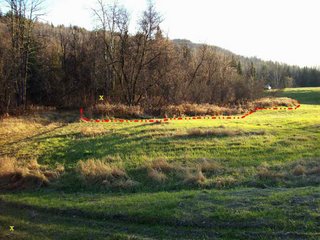
This afternoon I worked some more clearing brush from the east side towards the village. This is the end where we picked up more meadow than we thought existed. If you look at the photo you'll notice two yellow "X's" on the left of the photo. These are the "new found" boundary. Along the tree and grass line is a red dotted line I added to show where I am clearing brush. Essentially this is the piece we picked up during our survey.

Having a survey doesn't always mean you find more land. Many people find they have less than they thought they had. Having a survey defines boundaries using modern day equipment and good paper-trail research. To us there is no question about obtaining one. New businesses or businesses in motion like ours have enough things to coordinate than an unexpected dispute over who owns what.

Where the red dotted line crosses in front of the tall grasses will become the front edge of a massive shade garden. I am cutting out all the alders and poplars. These are both fast growing trees of absolutely no value. They are often diseased and die quickly. In spring we'll dig out the stumps and roto till the entire area in front of the tall trees and then we'll continue tilling around the entire property. Over time there will be a walking path and an ongoing display garden in front of the deer fence around the entire perimeter. Lots of work but it's part of our business plan to promote Vermont hardy plants and good landscapes.

Writing from the mountain above Peacham Pond where late November fog and warm temperatures will become snow, sleet or freezing rain come Saturday morning.

Gardening wishes,

George Africa

http://vermontflowerfarm.com/

http://thevermontgardener.blogspot.com/


Monday, November 27, 2006

Animal Visitors

Yesterday was another good day to work outside. I managed to get some more dead trees cut up and brought three loads of brush back here to the flower farm. An inquisitive traveler stopped by and wanted to know why I didn't stack up all the brush and burn it in place but I'm trying to keep the land pretty much the way it is right now.

In between refueling the saw, sharpening the chain and piling alder, I took a few breaks to continue with my mental inventory of the flora and fauna of this piece of property. I have noted signs of more animals than I have actually seen so far but it is clear that this is an important piece of land to a many animals.

The field has a number of woodchuck holes while the river banks and stone wall have fox dens with obvious activity. There is bear and raccoon scat on the river bank and mink tracks are common. Saturday morning before the sun got too high, the deer trails from the preceding night were obvious across the field. I have seen a couple sets of coyote tracks on a river bank and there is sign of beaver activity from perhaps 5 years ago. Only one red squirrel hollered at me from a young butternut tree but I suspect there are more there some place. It's nice to have such an assortment of animals around although the deer and woodchucks will have to be dealt with at some point which is why I'll probably resort to a fence. I should receive the final survey tomorrow or the next day so I'll be able to map out the fencing strategy.

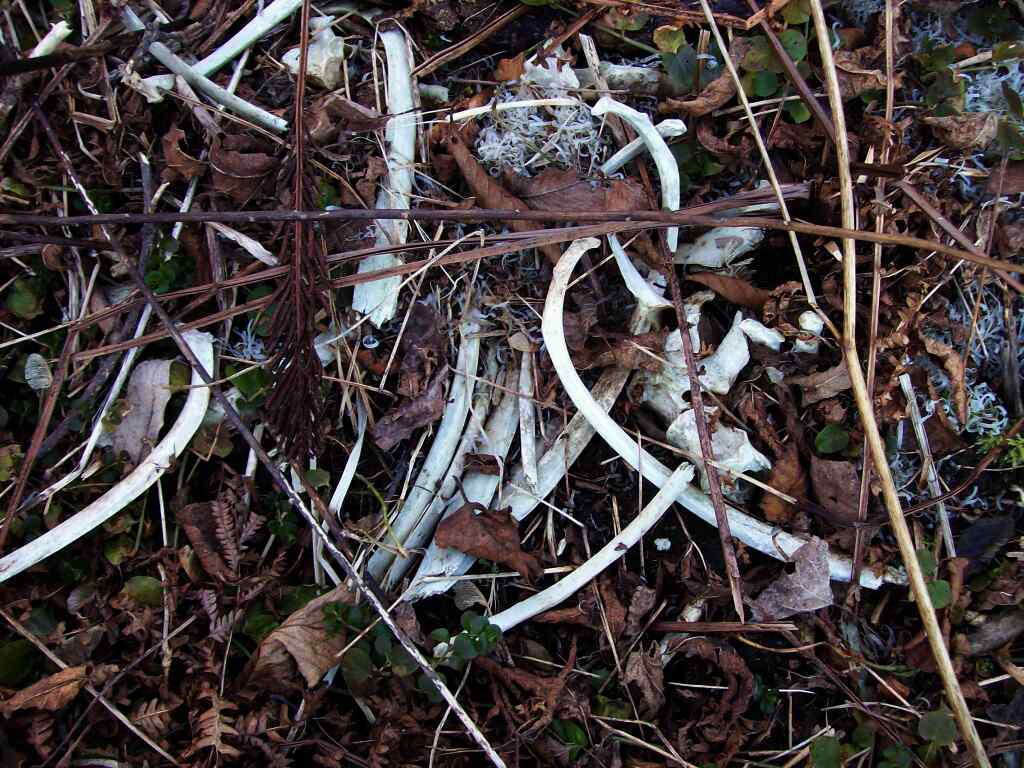
I located three different piles of deer bones representing animals which either didn't make it through previous winters or which were injured by cars along the adjacent highway and made it as far as the river to lay down. If you look closely at the picture above, you will notice the bone scrapings from the smaller critters of the forests and meadow lands who work secretly and almost unnoticed. Their sharp, ever-growing teeth can gnaw through calcium rich bones in short order.

Yes, yesterday was a very nice day to think about animal visitors and enjoy yet another spring-like day as December approaches.


Writing from the mountain above Peacham Pond, where chickadees frequent the flat feeder and bluejays compete for pieces of last evening's left over pop corn.

Gardening wishes,

George Africa
http://vermontflowerfarm.com
http://thevermontgardener.blogspot.com

Saturday, November 25, 2006

Riverfront, Oh Riverfront

A cold day at Vermont Flower Farm this morning but plenty of time to get caught up on what has been happening at Vermont Gardens. It's been a busy week between finishing up fall tasks and making it through Thanksgiving. The weather has been great and we're really proud of what we have accomplished.

Our surveyor got involved in the work we wanted done and we are very close to having a complete survey. This took a bunch of research time at the Town Clerk's office. That might be something you don't think is necessary when you hire a surveyor but a survey is something you only want to do once. You want to know all the previous land changes in the area and you want clear boundaries. This is difficult because in the old days, surveyors used trees and wire fences and stone walls and thrown up roads and railroads as boundaries. That was fine except that many of these are now nothing but history.

I asked our surveyor to do good research and then to mark the property so there was no doubt about any corner, any twist. He did just that and started the work at the edge of Marshfield Village where the corners were very well established and agreed upon. It looks to me like we picked up some land that wasn't advertised by the previous owner and realtor as belonging to this piece; we also "lost" some river frontage. It is also clear that the new road entrance the Transportation guys allowed in the recent Route 2 construction was in the wrong place and they built an access road on part of our land. Our land comes to the edge of the old access road to the state property and includes what used to be the area river users parked their cars. It will be more obvious when we put up some deer fence but that is now someone else's problem. We'll know for sure when everything is complete in another week but once again this points out the need to have a good survey before you buy land or make commitments or improvements. In contrast, finding the real property lines after you have installed a fence is not a great feeling. As soon as we receive our final survey, we'll post an example which should make the importance of the process stand more clearly.

River frontage is an important resource for a variety of reasons. In our case we need a good water supply and a river can be used for agricultural purposes without permitting as long as one doesn't change the water course or do anything which will affect the volumes. This river is the Winooski River. It starts up in the Walden mountains and in Cabot as streams which come together, little by little, until in Marshfield Village three different pieces of the watershed merge.

Gail and I laugh about river frontage because more and more you see real estate signs advertising river frontage. This summer a house sold in Plainfield ten miles from here and the river frontage amounted to looking out the house window and down thirty feet as the house was built right on the edge of the river. Lake and pond frontage is about spoken for in Vermont so river frontage has become more in demand.

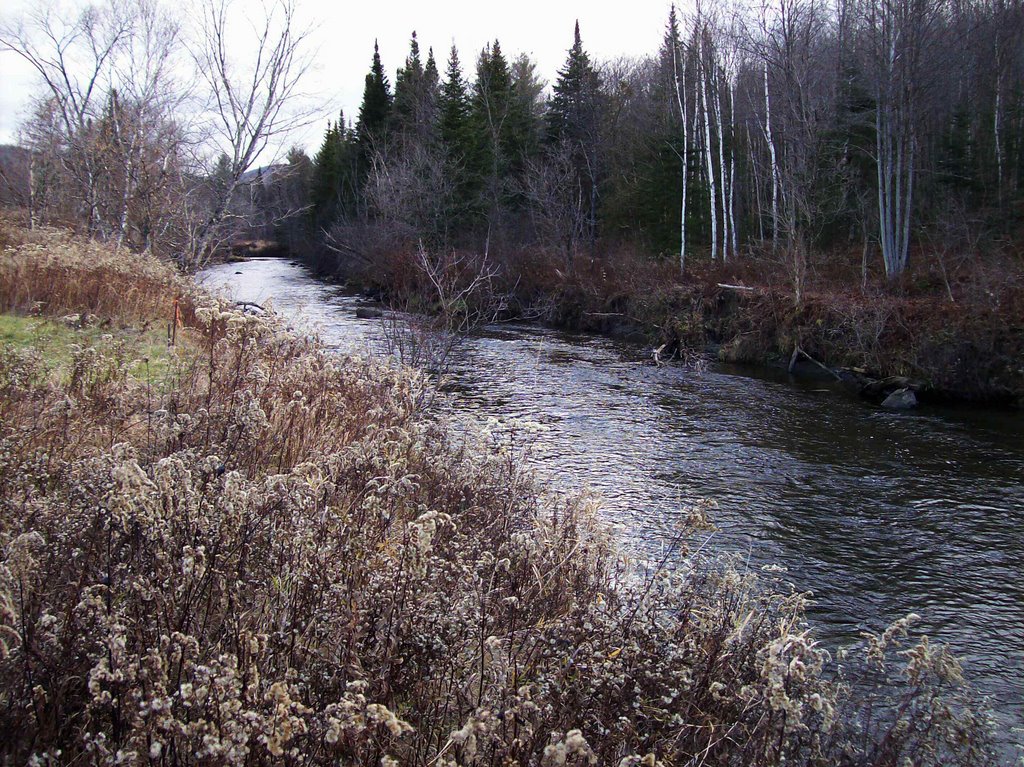
The Winooski River is a fine river as it heads for Montpelier and then north to Richmond, Essex and Winooski. "Our" piece of river is about 40-50 feet wide and a considerable distance down the bank on the property border. We intend to become involved with the Friends of the Winooski River, http://www.winooskiriver.org as their mission seems in keeping with some of what we believe in. As an organization they want to reduce pollution, promote improved wildlife habitat and encourage recreational opportunities. There's a lot of work to do along "our" river frontage, but over time we'll get things cleaned up.

As another week draws towards closure, we're happy with our progress. We have picked up a lot of trash river visitors left over the years, we've cut out the property lines and cut down dead trees for safety. We've begun an inventory of native trees, shrubs and plants, and we're making mental notice of where the red foxes den and where the deer and bear cross the river at night.

Writing from the mountain above Peacham Pond, where heavy frost clings tightly to everything
as the morning sun yawns "Good morning!" and rises, intent upon chasing it away.

George Africa
http://thevermontgardener.blogspot.com
http://vermontflowerfarm.com

Sunday, November 19, 2006

Start A Business Plan, Buying Land

Every day, thousands of Americans wake up and exclaim "Let's start a business!" Every day half the people who started a business fail. Within five years of the starting point, well under 5% still consider themselves in business. Part of the problem is understanding your business to begin with. To say that you know your intended business well and don't need a formal business plan is just another way to court disaster. It's almost inevitable.

Vermont Flower Farm started in Shelburne, Vermont in the early 1980s and made the move to Marshfield in 1989. By 1992 the original Vermont Herb & Flower Farm was reorganized with a reduced product line, no herbs, and a different marketing strategy. Three years ago a web site replaced a hand produced 44 page catalog. The overall strategy was meeting expectations close enough to consider the next step which was relocation to a more visible, higher traffic location.

The journey from Shelburne to Marshfield was a long one, with lots of hard work, some failures, and some interruptions. As we continued to grow our flower business, I thought seriously of writing a book to help others walk more easily the distance we had covered. I may still write that book some day. I have found one which satisfies much of what I wanted to say, I like the style, and the author is known as a successful person. That person is Tony Avent and his book, So You Want To Start A Nursery was published by Timber Press in 2003. If you're even remotely thinking of starting a nursery, read this book and keep reading this blog.

For three years I looked for land within a short drive of our current business but on Route 2. That road is one of three major east-west highways in Vermont. The other two include Route 9 parallel to the Massachusetts border, and Route 4 which travels from White River to Rutland-Fair Haven. Land on either thoroughfare is not easy to come by because people in the know think years ahead to what they envision the road, the businesses and the traffic counts to look like.

The Agency of Transportation has a friendly research section that counts vehicles instead of beans. They're very good at it. They do it with computers linked to lines permanently embedded in roadways, through digital counters and lines strung across roadways and with people positioned at key road points manually counting what goes by. These reports can help a potential business person figure out where traffic flow is greatest, where it is affected by seasonal influences and where it is just too limited to warrant consideration. I had looked at these reports for some time and although some properties came on the market between Marshfield and Danville, all reports suggested that our best bet was land located between East Montpelier and the junction of RT 215 (from Cabot) and RT 2 in Marshfield Village.

This spring a piece of land came on the market just west of the village on Route 2. It was advertised at 4.1 acres and listed at a price I had run numbers on with our business plan. I knew that if we could buy it within the asking price, we could develop it, make payments and move our business there over two years time. There were some interesting events along the way but the long and short of the story is that we closed on the land just after Labor Day 2006.

We knew that we had just bought a piece of land which bordered +800 feet on Route 2, was 472 feet deep on the west side, had about 500 feet on the Winooski River and was bordered on the east by a piece of land long since deeded to the State for a Fish and Game easement. We also knew that the land was heavy clay soil, and was 2/3d in the Winooski River floodplain and 1/3d zoned agricultural. We knew where the water came off the mountain across the road and knew how high the Winooski River raised each day when Green Mountain Power released water to make electricity. Electric service was located across Route 2 and that would mean a $3000 price tag to bring power across the road. Water would have to come from the river via a gas pump and an access entrance road approved by the Agency of Transportation would have to be built. The list of ancillary items was longer than one might like but within our budget.

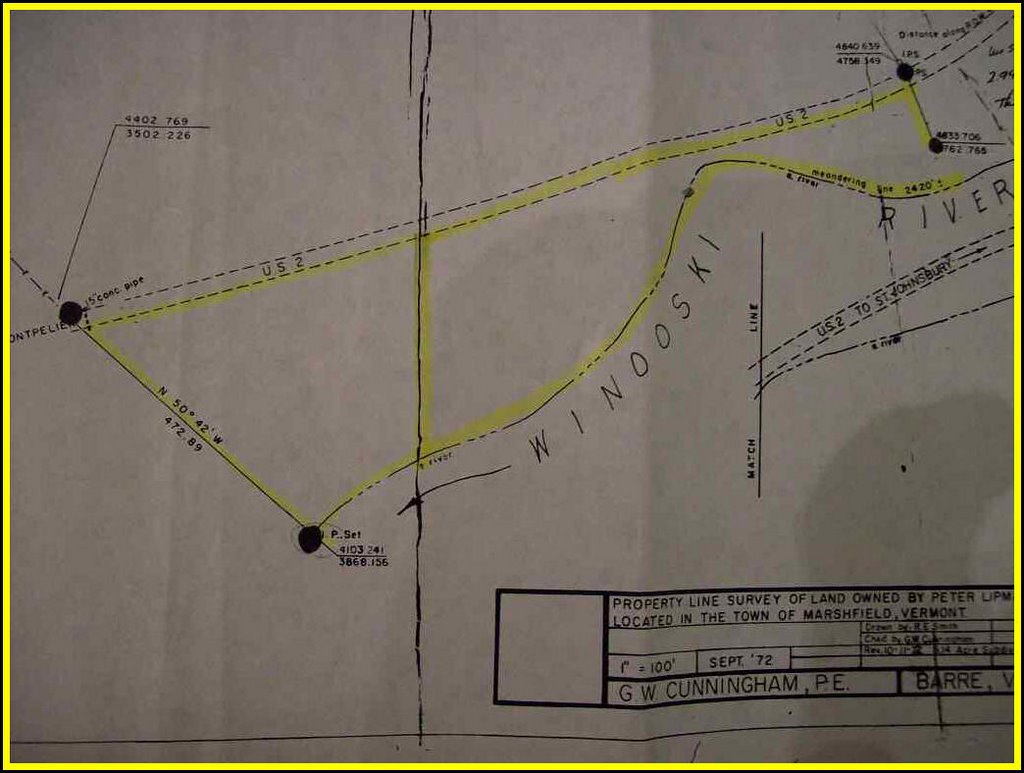
The land had been surveyed and recorded in 1972 but some of the lines had been disrupted and trees that had served as markers had died and rotted into nonexistence. When the highway guys replaced an aging culvert on the west end, they dug up one marker and replaced it with new road and no marker. As Route 2 was raised and replaced over the years, other markers became obscured. A new survey seemed appropriate.

This may seem like a formidable list of items needing attention but it's calm compared to many business plans. There's no pressure for us to open next season and no other burdens beyond what we have committed to so far. The point of detailing this process is the reflection that a business plan is a "must", contingencies have to be realistic and the best of plans will still go off track somewhere.

The map pictured above is the 1972 version we went by to make our purchase. We confirmed the approximate location of two missing markers, identified three pins and a marked tree and then asked for a computer analysis of the approximate acreage. When that exceeded the listed estimate, we proceeded with the purchase. If you are considering a nursery or any other business, follow these examples.


Writing from the mountain above Peacham Pond, where a good business plan makes sense for any business.

George Africa
http://vermontflowerfarm.com
http://thevermontgardener.blogspot.com

Sunday, November 12, 2006

Welcome To Vermont Gardens

Welcome to Vermont Gardens! If you have had the opportunity to visit Vermont Flower Farm, either by web at http://vermontflowerfarm.com or in person up on the mountain above Peacham Pond in Marshfield, Vermont, you already know what a growing nursery business this is. The interesting evolution of our nursery from its days as Vermont Herb & Flower Farm in Shelburne, Vermont is explained on our home page.

Since 1992 we had been growing bigger in Marshfield. We reached the point where rebirth in a new location seemed to make sense. This new blog will complement The Vermont Gardener http://thevermontgardener.blogspot.com bringing garden updates during the growing season and garden thoughts and conversation the remainder of the time. Vermont Gardens will show the development of a new nursery from the time the land was purchased through it's first years of operation. As the nursery and Vermont Gardens grows, we'll integrate some stories about other Vermont gardens and nurseries which we enjoy. We will also weave in some local stories and personalities, bits of ecology and observations about our new project, the land it encompasses and the Winooski River which it borders. We hope you'll read and enjoy Vermont Gardens just as you have told us you enjoy The Vermont Gardener.

Gardening wishes,

George, Gail and Alex Africa